 ChainRepro
Inside a Top Solana Arbitrage Bot: $923 in 29 Minutes
ChainRepro research · 29 September 2026
Outcome: Transaction explained. Historical observation of one wallet over 29 minutes. Recurrence and anyone else's ability to capture these trades were not tested.
The Answer
In 29 minutes, the arbitrage wallet MriyaNN8…PQu7X netted $922.81 (about 7.85 SOL) after every fee and tip. That is a rate of roughly $1,900 per hour.
- It sent 975 transactions: one every 1.8 seconds.
- 59% of them failed. Failures cost it $41.
- It paid $324 in fees and Jito tips to get its trades included.
- The median winning trade earned $0.45. The best earned $115.57.
- It operates with roughly $110,000 of capital on hand.
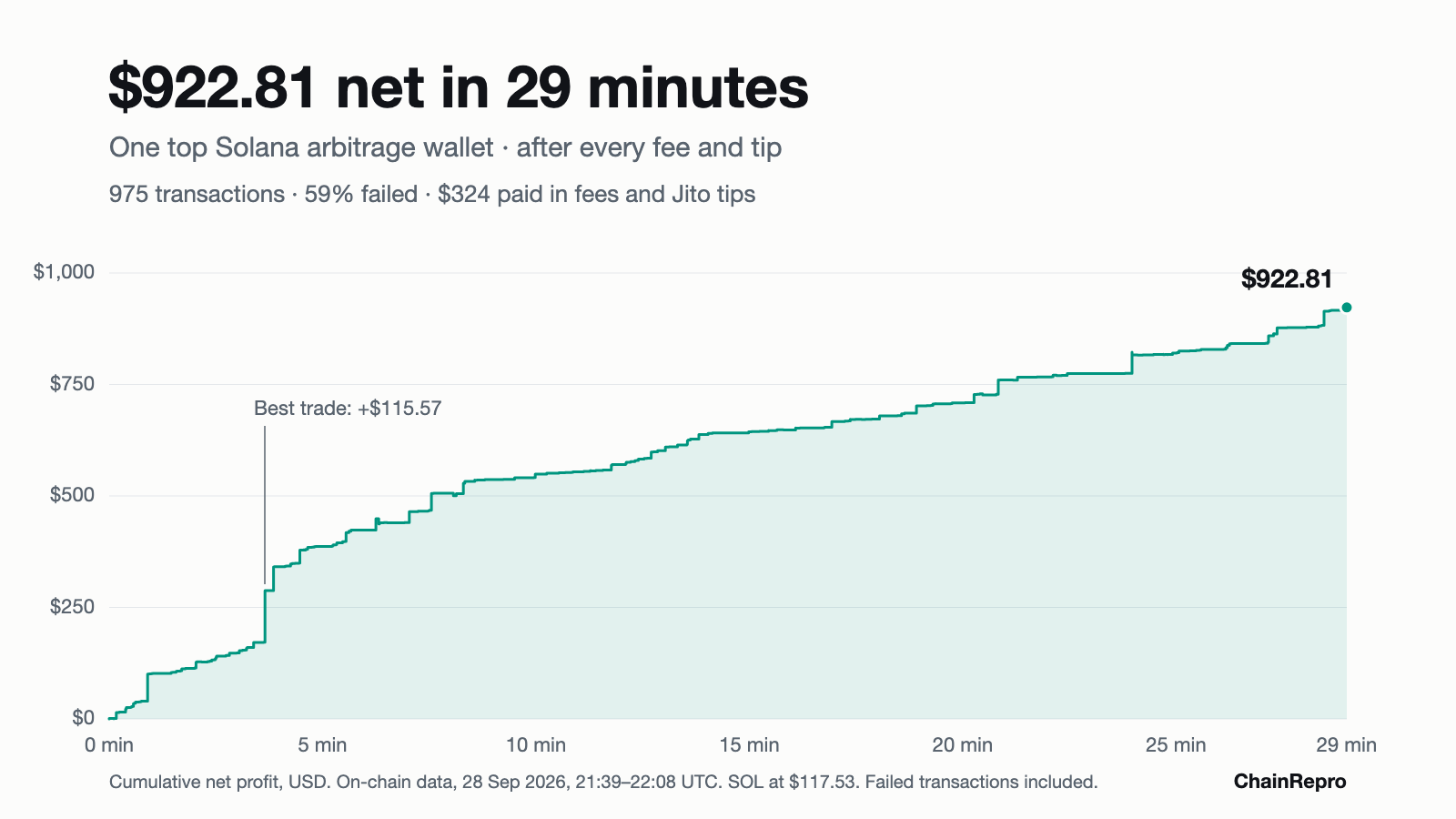
It wins by trading memecoins between exchanges faster and more often than anyone else, not by finding rare opportunities.
How This Bot Was Selected
We sampled 300 Solana blocks spread across one hour on 28 September 2026 (about 369,000 transactions) and looked for self-contained arbitrage: transactions that start and end in the same token and leave the wallet with more of it. Several of the largest apparent earners turned out to be withdrawals or payouts rather than arbitrage. We then checked the top repeat wallets transaction by transaction. MriyaNN8… was the highest-earning wallet whose trades were confirmed as complete arbitrage cycles. It is one of the top performers, not a typical bot.
We did not write or operate this bot. All data is public.
Question and Method
Question, fixed before analysis: what does this wallet earn per transaction, net of all costs, over its most recent 1,000 transactions?
- Sample: its 1,000 most recent signatures, frozen before analysis. 978 were retrieved; the 22 that could not be fetched are excluded.
- Window: 21:39:40–22:08:40 UTC on 28 September 2026.
- Every transaction counts, failures included.
- Net result = the wallet's native SOL change + wrapped SOL (including account rent) + USDC/USDT change. Tokens without a price are listed separately, never counted as zero.
- Costs are itemised from each transaction: base fee, priority fee, Jito tips, and any other SOL payments inside a trade.
- External transfers are excluded. One transaction sent 10.02 SOL to another wallet (
ForJ…) that also appears in this sample, most likely the same operator moving funds. It is not trading and is left out. Two transactions from that second wallet are also excluded. - SOL price: $117.53, the market rate when the analysis was run. Almost all profit is taken in SOL, so results scale directly with this price; figures in SOL are given alongside.
Results
| Transactions analysed | 975 |
| Successful / failed | 404 / 571 (58.6% failed) |
| Net result, all costs included | $922.81 (7.85 SOL) |
| Successful trades, total | $964.23 |
| Cost of failed transactions | −$41.42 |
| Median successful trade | $0.45 |
| Mean successful trade | $2.39 |
| Best trade | $115.57 |
| Successful trades that still lost money | 8 (worst −$0.23) |
| Successful trades under $1 | 68% |
The profit is spread wider than a lucky streak, but still skewed. The single best trade made 12.5% of the total; the ten best made 45%. Most trades earn cents to a few dollars.
What It Pays to Win
| Cost | SOL | USD |
|---|---|---|
| Priority fees | 2.3322 | $274.10 |
| Jito tips | 0.4174 | $49.06 |
| Base fees | 0.0049 | $0.57 |
| Total inclusion costs | 2.7545 | $323.73 |
Of about $1,247 in gross arbitrage profit, roughly 26% went to getting trades included in blocks. Priority fees are paid even when a transaction fails: the most expensive failed transaction cost 0.1 SOL ($11.75).
Capital
At the end of the window, the wallet held about 86.6 SOL and 100,455 USDC: roughly $110,600. It had also just moved 10 SOL to a related wallet. That balance lets it take the full size of each opportunity immediately, without borrowing.
What It Trades
The largest trades we checked are memecoin round trips: SOL is swapped into a token on one exchange and back into more SOL on another, in a single transaction.
Its biggest trade bought about 1.83 million units of one token for 16.01 SOL and sold them for 17.63 SOL, a gross gain of about 1.5 SOL.
Exchange programs used, by number of transactions (failures included): Meteora DLMM (701), PumpSwap (616), Raydium CLMM (181), Orca Whirlpool (119), Meteora DAMM v2 (72), Raydium CPMM (37). Tokens trading on both PumpSwap and Meteora pools appear to be a frequent source of the price differences it captures.
Our Own Attempt
We built a similar multi-venue arbitrage engine with an on-chain profit guard. Between 7 and 16 May 2026 it sent 58 live transactions. All 58 realised exactly zero: the balance it was trading never changed, because the opportunity was gone by the time each transaction executed.
The engine's estimates showed a median expected profit of 16.6%. They were computed from stale pool state; faster bots had already closed every gap. The on-chain profit guard meant a missed opportunity could not become a loss.
We spent months on that engine: about 28,000 lines of Rust, exact price math for seven exchange types, Jito submission, and an on-chain program that refused any trade that didn't end in profit. Technically, it did what it was designed to do. What it could not do was see prices early enough. It learned about pool changes from RPC updates hundreds of milliseconds late, then simulated each trade before sending it, so every opportunity it acted on had already been taken. Watching this bot confirmed what those 58 zeros suggested: the winners are not writing smarter routing code. They read the chain earlier, send faster, keep six figures of inventory ready, and accept paying for hundreds of failed attempts to win the ones that count.
What This Means
- The top bots do make real money. This one netted about $920 in half an hour after all costs.
- It is a volume and speed business. One transaction every 1.8 seconds, most of them failing, and a median win of 45 cents.
- Getting included is expensive. A quarter of gross profit went to priority fees and tips, paid whether trades succeed or not.
- Capital is a requirement. About $110,000 on hand to trade full size instantly.
- Memecoin fragmentation is the opportunity. New tokens trading on several exchanges at once create the price gaps these bots close.
Arithmetic, not a forecast: $922.81 in 29 minutes is about $1,900 per hour. Sustained all day, that would be roughly $46,000. We do not expect that to hold: memecoin activity and competition change hour to hour, and a few large trades carry a significant share of the result.
Limitations
- One 29-minute window of one wallet, chosen because it was among the top earners. Other bots, times and market conditions will look different.
- 22 of 1,000 transactions could not be retrieved and are excluded.
- The SOL price is the rate at analysis time, not the exact price of each trade.
- The operator may use other wallets (at least one related wallet appears here). This covers one wallet only.
- No infrastructure costs are included: servers, data feeds, RPC and transaction-sending services.
- Historical observation only. It shows what this wallet earned, not what anyone else could capture.
Evidence
| File | Contents |
|---|---|
evidence/sample_slots.json |
The 300 slots sampled to select the bot |
evidence/arb_transactions.jsonl |
Arbitrage candidates found in the block sample |
evidence/cycle_check.json |
Full-transaction cycle verification of the top repeat wallets |
wallet-evidence/frozen_sample.json |
The wallet's 1,000 signatures, frozen before analysis |
wallet-evidence/transactions.jsonl.gz |
Raw transactions as retrieved (978), gzip-compressed |
wallet-evidence/per_transaction.csv |
Net result, costs and venues per transaction |
wallet-evidence/summary.json |
Totals and cost breakdown |
wallet-evidence/final_numbers.json |
Final figures after excluding the external transfer |
Transactions to verify on Solscan:
- Best trade, +$115.57 (16.01 SOL in, 17.63 SOL back):
2buEQoG2HUmdFrRbm5wsoUiraRdJVp3Ku15eBMzrwznVxt5ZFU3KcnUr1piw6maG9eR2PrrsofMfK9iZuhDUtTAs - Second-best trade, +$60.84:
2tHpeGpw68bt54zqbz8mScQyH7LndtNvYCHcnLSbEwzUYhWtYxMSCoHqc3Rfimk82S3iAcRhYciVsDy1AR8yWEru - Three-leg trade, +$41.82 (SOL → token → token → SOL):
4M9Lnh3XZUVf1MX2LWTN84Wxi8dMyPLmF7nU97iWEB3wTiMZvtoQD3dewtYGaXgvaJbqa3vEqmMREcT7A1ddRCB
Reproduce: download the scripts and evidence, then run python3 scripts/analyze.py wallet-evidence and python3 scripts/final_numbers.py wallet-evidence for the wallet figures. python3 scripts/scan_blocks.py evidence 300 9000 repeats a block sample (set SOLANA_RPC_URL to your own RPC endpoint; a new run samples newer blocks).
Not financial advice. This report describes historical on-chain activity and does not recommend any trading strategy.
Questions or corrections: alex@chainrepro.xyz. Need this kind of analysis for your protocol? See our services.